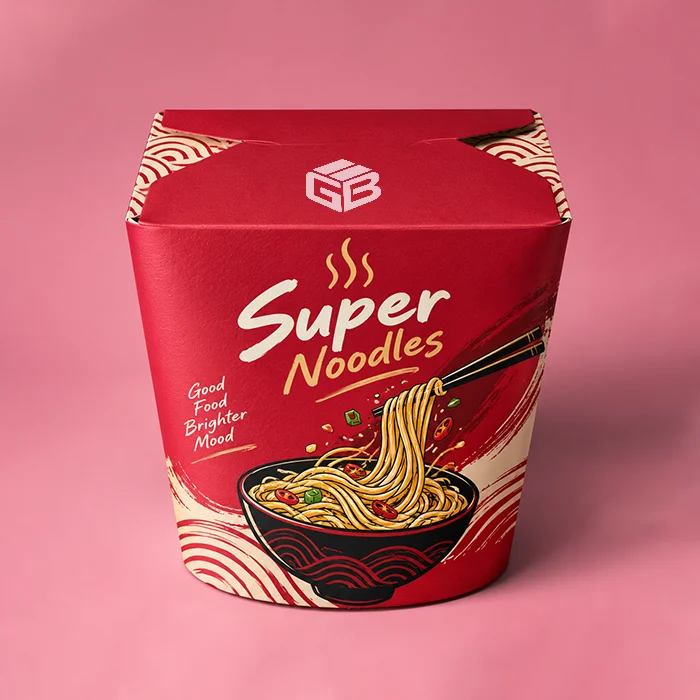
A noodle box should make a takeaway meal easy to fill, carry, and enjoy. Its shape, closure, and printed details all contribute to the serving experience. Kraft paper noodle boxes combine a natural-looking appearance with a format designed around hot, saucy, and convenient food service.
The starting point is suitability. Before choosing artwork or ordering a particular size, establish what food the box will hold and how it will be packed. The material, construction, and printed details should be assessed together rather than selected only for their appearance.
Review the noodle dishes that will use the box and how staff will prepare orders. A box for a single portion needs a different arrangement from one holding a meal with toppings, sides, or sauces.
Consider how the food is served, whether it is hot or cold, and how long it may remain in the package before collection or delivery.
A useful packaging brief should cover:
The food items and portion sizes
Whether the box will hold one item or several components
Expected temperature and holding conditions
How staff will fill, close, and label orders
Whether customers will carry it, collect it, or have it delivered
Any required food information or labeling
These details help identify the right structure and size before artwork begins.
Measure the food in the condition in which it will be packed. Include noodles, sauce, toppings, and any separate components.
Confirm whether quoted measurements refer to the internal or external dimensions of the finished box. Account for the space needed to close the top securely.
The meal should fit without pressing against the lid or making the box difficult to close. Excess space should also be reviewed, especially if it allows the contents to move during handling.
Test the proposed size with the actual menu items before approving production.
Ask the supplier to identify the paper, lining, coating, closure, and any additional components included in the finished box.
Do not rely on the word “kraft” as a complete material specification. Discuss the food’s temperature, moisture, oils, and expected contact time, then request information relevant to that application.
If food contact is involved, ask for documentation covering the finished printed box under the proposed conditions. A statement about the unprinted material should not automatically be extended to the complete construction.
Keep the approved specification with the order details so repeat orders can be checked consistently.
Review the proposed closure with a fully packed box rather than an empty sample. Check whether it remains secure when lifted, carried, and placed in a delivery bag.
If the design includes vents, dividers, or a separate lid, give each feature a defined purpose. It should support food handling rather than add complexity without benefit.
Check how the box opens and how easily customers can reach the contents. A practical design should remain convenient throughout the meal.
Assess the complete package as staff will use it during service.
Plan the logo, graphics, and text on the assembled box rather than treating the design as a flat layout.
Keep important details away from seams, folds, and the closure area unless their placement has been checked carefully. Consider how the kraft surface will affect the printed colors and contrast.
A restrained design might use a single logo and a short wordmark. A more expressive direction could include illustrations or a repeating pattern.
The artwork should remain connected to the business’s established identity and other takeaway materials.
Shipping labels, order details, and any additional food information should be part of the original layout. Choose a clear area that can accommodate labels without covering essential branding or instructions.
Reserve space for required food information, date labeling, or other details relevant to the business’s operation. Have labeling requirements reviewed by an appropriately qualified person for the specific food and market.
If a separate label is used, check its position on every proposed box size. A layout that works on a large lid may not suit a smaller format.
Review the finished package as the customer will receive it, not only as an unfilled printed sample.
Food packaging should describe the contents accurately. Avoid adding health, safety, or environmental claims without a clear basis relevant to the product or finished packaging.
Words such as “fresh,” “healthy,” “natural,” or “eco-friendly” should not become casual substitutes for a precise description. Any statement needs appropriate support.
Keep promotional language separate from practical information. Customers should be able to identify the meal and follow any necessary handling guidance without confusion.
Review the overall impression created by text, symbols, and illustrations—not just individual phrases.
Request supporting information before describing the box as recyclable, compostable, biodegradable, or environmentally preferable.
Any statement should relate to the complete construction and relevant disposal custom noodle boxes wholesale. Do not assume that a claim about the outer kraft layer also applies to a lining, coating, or adhesive.
If components require separate handling, make any guidance clear and appropriately qualified. Avoid using decorative symbols in a way that could be mistaken for verified certification.
Specific wording is more useful than a broad environmental promise.
Ask the fulfillment team to pack sample boxes using the actual food, closure, labels, and any additional components.
Look for difficult closures, unclear orientation, awkward stacking, or steps that require repeated adjustment. Check whether staff can identify different menu items quickly.
Review the completed package for alignment, closure, accessibility, and presentation. Record the approved packing sequence so it can be repeated consistently.
Assess the delivery arrangement separately if orders will be shipped. A takeaway box should not automatically be treated as sufficient transport protection.
When reviewing quotations, compare matching dimensions, materials, printing, closures, and included components. Clarify sampling, artwork preparation, delivery terms, and production quantities.
Choose quantities that reflect realistic demand and available storage. Consider whether menu names, seasonal artwork, or branding may change before the boxes are used.
Before final approval, check the physical sample alongside the artwork proof. Confirm fit, closure, spelling, food information, and panel orientation.

This post has been authored and published by one of our premium contributors, who are experts in their fields. They bring high-quality, well-researched content that adds significant value to our platform.







Daily Food brings you recipes, cooking tips, food ideas, and useful information for food lovers. Discover fresh ideas and make every meal more enjoyable.